Forest Restoration
We recover degraded areas, promoting the return of biodiversity and essential ecosystem services. We carry out planting, monitoring and maintenance, with replanting when needed, using proven techniques.
- ✓ Diagnosis and customized restoration plan
- ✓ Planting with native species from the region
- ✓ Continuous monitoring for at least 2 years
Agroforestry Systems (AFS)
We implement agroforestry systems that integrate trees and crops, optimizing land use, increasing productivity, and contributing to food security and farmers' income.
- ✓ Intercropping of trees with short- and long-cycle crops
- ✓ Increased income for rural producers
- ✓ Soil recovery and food security
Volunteer Planting Drives
We organize collective tree-planting events, engaging volunteers in the recovery of degraded areas — at schools, companies, public spaces and communities.
- ✓ Full setup: seedlings, tools and technical team
- ✓ Engagement and ESG activity for companies
- ✓ Photo record and certificate of participation
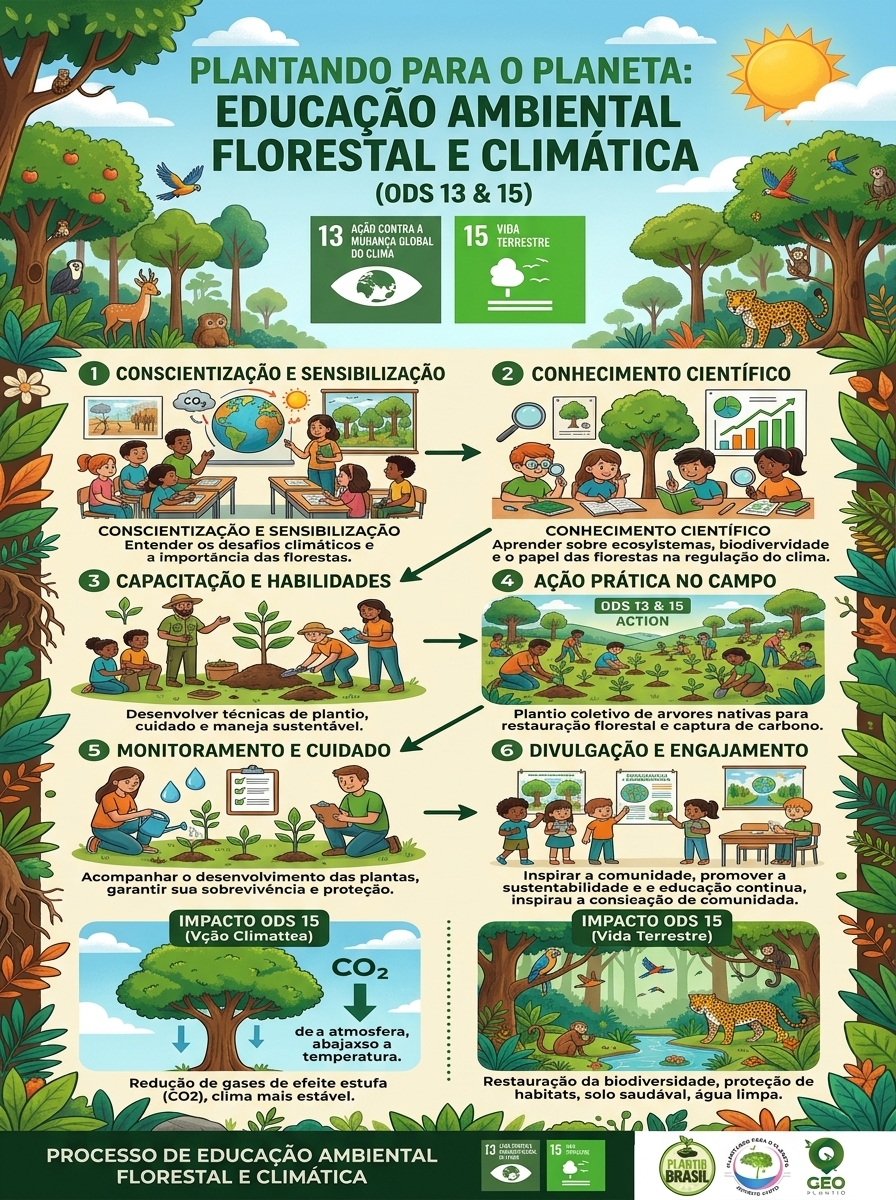
Environmental and Climate Education
We use our own materials: the "EA Booklet – Caring for the Planet" and the textbook "Planting for the Planet." We are now developing an app with our content. Workshops, talks and training programs for multipliers, communities and schools on sustainability and climate change.
- ✓ Content tailored by audience (schools, companies, communities)
- ✓ Training of environmental multipliers
- ✓ In-person or hybrid format
Environmental Compliance for Rural Properties
We help rural landowners, with personalized legal support, regularize their land in line with environmental legislation, integrating conservation and sustainable production.
- ✓ Compliance diagnosis (Rural Environmental Registry, Legal Reserve, Permanent Preservation Areas)
- ✓ Preparation of an Environmental Recovery Plan
- ✓ Full legal follow-up
Urban Forestry
Planning, deployment and management of trees in public and private spaces, including georeferenced tree inventories, for the health and sustainable development of green areas.
- ✓ Georeferenced tree inventory
- ✓ Species selection compatible with urban infrastructure
- ✓ Ongoing pruning and management
Gardening and Green Area Maintenance
Creation and maintenance of gardens: pruning, mowing, fertilizing, pest and disease control, and irrigation. We take care of your home, condo or business with dedication and expertise.
- ✓ Recurring or one-time maintenance
- ✓ For homes, condos and businesses
- ✓ Our own specialized team
Agroforestry Nursery
Production, sale and distribution of native forest seedlings and agricultural seedlings, in partnership with the Córrego do Macuco Quilombola Community, Conceição da Barra/ES underway.
- ✓ Seedlings with guaranteed origin and quality
- ✓ Partnership that generates income for the local community
- ✓ Large-scale supply for projects

AgroTechWay
Technology applied to agriculture and food production chains, combining data, monitoring and innovation to make agri-food production more sustainable, traceable and regenerative. We are developing a pilot project under the AgroTechWay brand for the specialty coffee chain, starting from planting.
- ✓ Technology applied to sustainable agri-food production
- ✓ Traceability and data for regenerative production chains
- ✓ Connecting producers, market and innovation
Other Projects
Expanding initiatives that broaden our socio-environmental impact into new areas of work expanding.
- ✓ ClimateLabs — Smart Climate Communication Lab
- ✓ Circular Productive Backyards — 60 projects for Quilombola Communities
- ✓ Training and Strengthening of Urban and Peri-Urban Agriculture (AUP) Territorial Networks