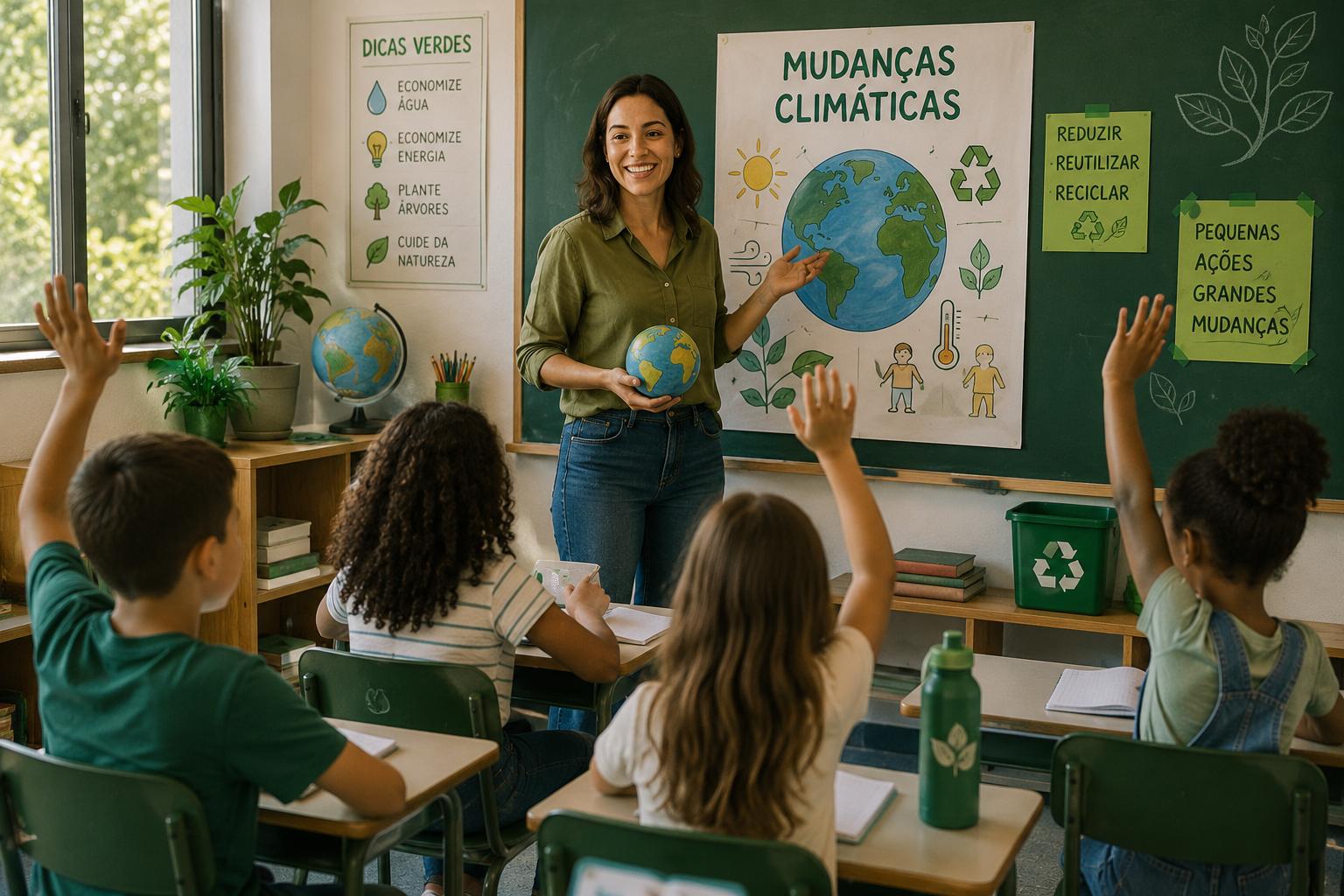
Talking about climate change with children and teenagers requires a delicate balance: information serious enough to build real awareness, but presented in a way that doesn't paralyze them with fear. That's the balance we aim for in every environmental education workshop GeoPlantio brings to partner schools.
Our climate education program was born from a simple observation: forest restoration without environmental education has a limited shelf life. Planting trees solves part of the problem today; raising people who understand and protect those trees tomorrow is what makes the impact last for generations.
The workshop format
We work with elementary and high school classes, adapting language and content depth to each age group. The workshops combine three moments:
- Basic concepts: what climate change is, the greenhouse effect, and how deforestation and forest restoration relate to the topic — always with concrete examples from the school's own region.
- Hands-on activity: seedling production in a school nursery, planting around the school grounds, or local biodiversity observation activities, depending on available infrastructure.
- Multiplication: training "environmental ambassadors" within the class itself, students who become a reference for their peers and carry the content home to their families.
Why the "multiplier" concept works
Over the course of these projects, we've noticed that environmental education's greatest reach doesn't come from the number of students who take part directly in the workshops, but from what those students carry outside the school. A child who plants a seedling and understands why that species was chosen tends to talk about it at home — and, without realizing it, becomes a bridge between our team's technical content and the community around the school.
That's why we structure workshops with the explicit goal of forming multipliers, not just transmitting content. This changes how we run activities: instead of lectures, we prioritize open questions, group discussions, and hands-on challenges that students can repeat later on their own, without needing our team present.
"The question I love hearing most at the end of a workshop isn't about the subject matter — it's 'can I take a seedling home to plant?'" — Helenice Geralda Silva, Environmental Educator, GeoPlantio
Connecting theory and territory
A common mistake in climate education content is treating it as an abstract, distant topic — melting glaciers, events on other continents. We prefer to start with the territory: what's happening to the region's rivers, to the rainfall, to the native vegetation still standing around the school. This local framing makes the content tangible and, more importantly, makes the action — planting, caring, observing — something the student can actually do, not just watch from afar.
Partnering with schools: how it works
Public and private schools can become partners in GeoPlantio's environmental education program. The process starts with a conversation about the school's reality — whether there's already a garden, nursery, or green area available — and from there we design a workshop schedule that can range from a one-off session to an ongoing program throughout the school year, integrated into the science or geography curriculum.
In several cases, school workshops connect directly to GeoPlantio's planting drives: classes that produced seedlings in earlier workshops take part, months later, in planting those very seedlings in restoration areas — closing the full cycle, from seed to forest.
Results that go beyond the grade
We don't measure this program's success only by learning indicators. We measure it by the number of students who come back asking about the topic months later, the families who start sorting their trash better at home, the teachers who begin weaving the theme spontaneously into other subjects. It's a harder impact to quantify, but it's exactly the kind of lasting behavior change we're aiming for.
Want to bring climate education to your school?
We design custom environmental education programs for public and private schools.
Talk to our team