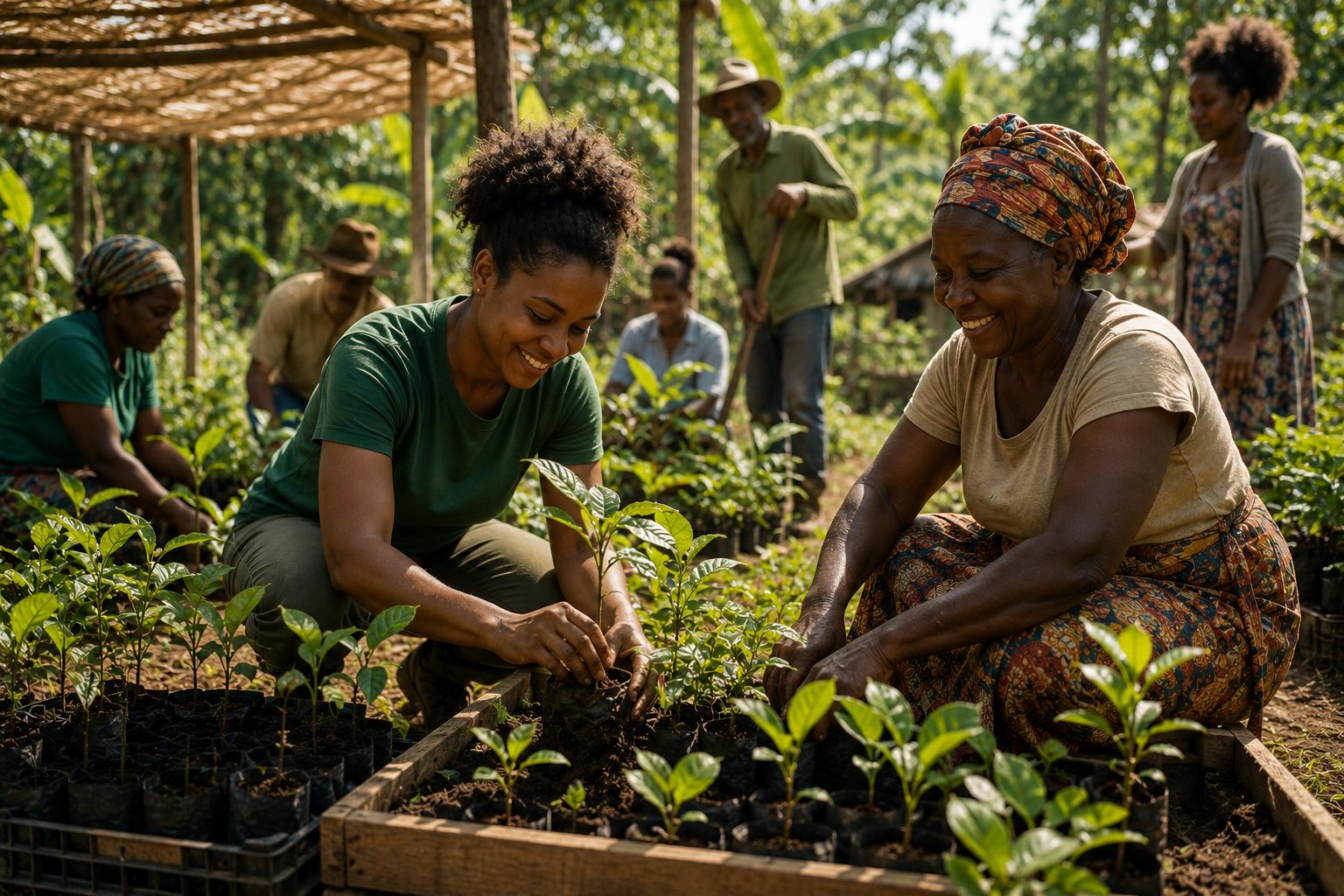
In Conceição da Barra, in the north of Espírito Santo, the Córrego do Macuco Quilombola Community carries centuries of relationship with the land. It's on this territory that GeoPlantio is setting up, in direct partnership with Quilombola families, an agroforestry nursery that combines native seedling production, local income generation, and the strengthening of traditional knowledge.
The project was born from a simple question: how do you restore forest without displacing the people who have already cared for it for generations? For us, the answer has always been to work together — not as a company arriving from outside to "save" a territory, but as a technical partner to communities that already deeply understand what it means to plant, harvest, and live off the land.
Why a nursery inside Quilombola territory
Historically, forest restoration projects buy seedlings from distant nurseries, transport them hundreds of kilometers, and in doing so lose two essential things: the genetic adaptation of species to the local microclimate, and the opportunity to generate income within the very community that will live alongside the restored forest.
By setting up the nursery inside Córrego do Macuco, we solved both problems at once. The seedlings produced there grow from seeds collected in the region itself — which increases survival rates at planting — and every stage of production, from seed collection to seedling management, is paid work carried out by community members.
The first steps of the partnership
The process began with conversation circles. Before any physical structure was built, we spent months listening to Quilombola leaders, understanding the community's agricultural calendar, mapping who had interest and availability to take part in seedling production, and aligning expectations about timelines, pay, and responsibilities.
That early care isn't bureaucracy — it's what guarantees the project truly belongs to the community, rather than simply being done "for" it. Only after that alignment did we move on to the technical steps:
- Site diagnosis: choosing the nursery site based on water access, sunlight, and proximity to the families involved.
- Technical training: hands-on workshops on seed collection, germination, transplanting, and seedling management in bags and tubes.
- Physical setup: installing shade cloth, benches, an irrigation system, and an acclimation area.
- Priority species selection: jointly choosing the native Atlantic Forest species most relevant for restoration and for the community's own traditional uses, such as fruit and medicinal plants.
Income generation as part of the design, not a side effect
A common mistake in socio-environmental projects is to treat income generation as a welcome byproduct. At GeoPlantio, it's part of the design from day one. Every seedling produced at the nursery has a value defined jointly with the community, and payment happens by production stage — seed collection, germination, management, and seedlings ready for planting.
This model creates a more predictable income flow than other seasonal activities, and lets families plan their participation according to their own availability. It also opens space for the nursery itself to become, in the medium term, a source of income independent of GeoPlantio's projects, supplying seedlings to other buyers in the region.
"We don't want to own the nursery. We want it to work so well that, a few years from now, the community won't need us to operate it anymore." — GeoPlantio technical team
What's already been planted
In its first months of operation, the nursery has already produced thousands of seedlings of species such as ipê-amarelo, jequitibá-rosa, pau-brasil, aroeira, and embaúba — all native to the Atlantic Forest biome and adapted to the warm, humid climate of the northern Espírito Santo coast. These seedlings are being used both for Permanent Preservation Area (APP) restoration projects in the region and for environmental offset plantings by partner companies.
Beyond its ecological potential, each seedling carries a story: that of a community that decided to take technical ownership of forest restoration, instead of simply watching it happen around them.
Next steps
GeoPlantio's goal for the coming cycles is to double the nursery's production capacity, expand the number of families involved, and create an origin seal that identifies seedlings produced in Córrego do Macuco across every restoration project that uses them. We're also structuring an ongoing training program so community leaders can progressively take over the nursery's technical and administrative management.
This is the kind of project that reinforces something we believe deeply: real forest restoration doesn't happen despite local communities — it only lasts when it happens with them, paying for their knowledge and strengthening their permanence on the land.
Want to bring a project like this to your region?
GeoPlantio designs custom forest restoration projects and community nurseries for companies, municipalities, and communities.
Talk to our team