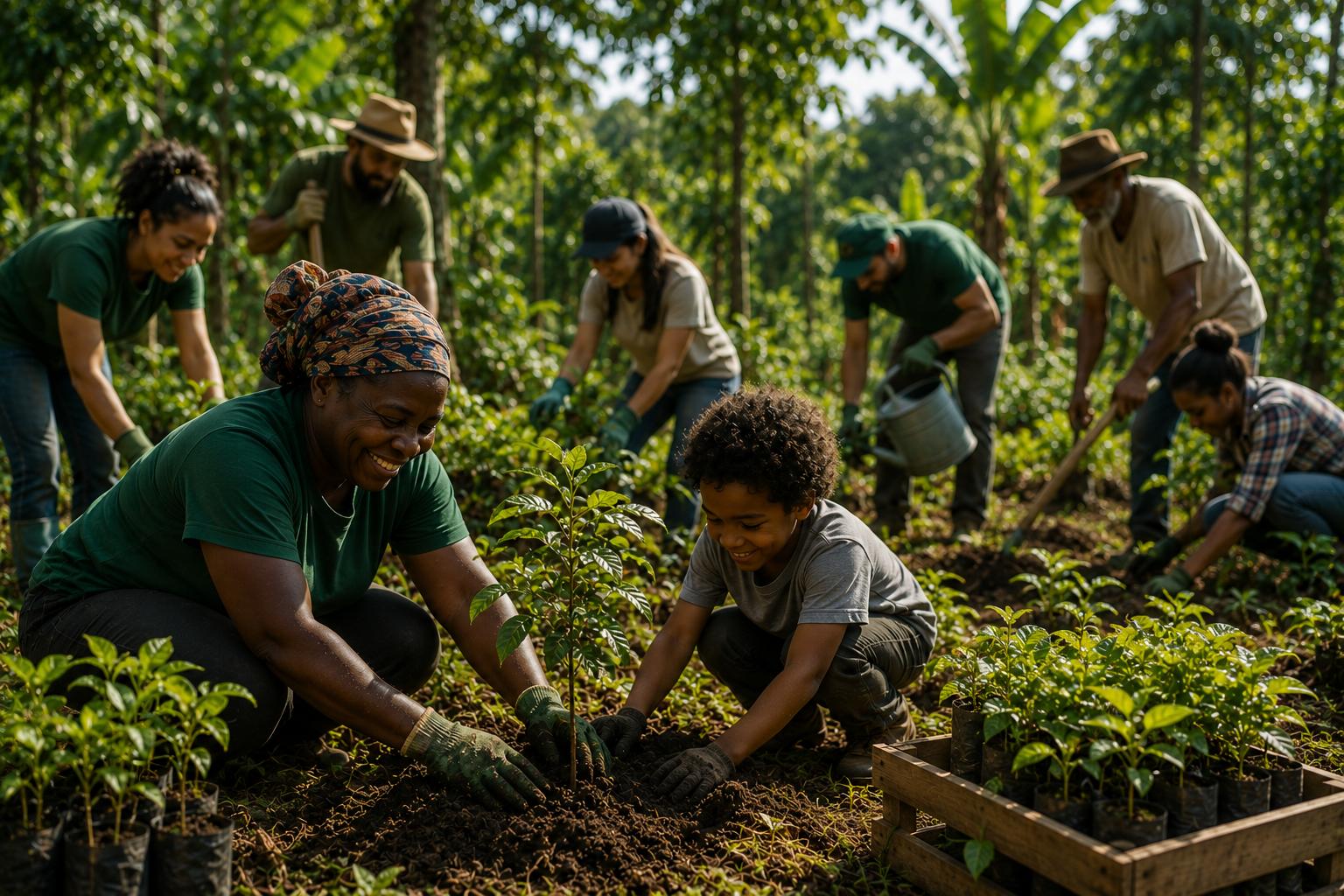
There's a sound that marks every GeoPlantio planting drive: the thud of a hoe opening a hole, followed by laughter, conversation, and the focused silence of someone placing a seedling in the ground for the first time. In this article, we walk through how a planting drive day works and why these gatherings matter so much to our mission.
A planting drive brings together volunteers, local community residents, employees from partner companies, and sometimes students from nearby schools, for a single day of collective work. The goal is to plant hundreds — in some cases thousands — of native seedlings in restoration areas, always with technical support from our forest engineering team.
How a planting drive is structured
Before the first volunteer arrives, the site has already gone through extensive technical work: soil diagnosis, species selection, hole marking, and land preparation. That means when the drive happens, participants can focus entirely on the planting itself — no prior technical knowledge required.
The day usually follows a simple structure:
- Welcome: an introduction to the project, the site, and the goals of that specific planting.
- Quick planting workshop: our team teaches the correct planting technique — hole depth, fertilization, and how to position the seedling to ensure healthy development.
- Group assignment: volunteers organize into pairs or trios, each responsible for a sequence of holes.
- Planting: the main stage, which can last two to four hours, depending on the size of the area and the number of participants.
- Recording and celebration: at the end, we count the number of seedlings planted and record the georeferenced location of each one for future monitoring.
Why volunteer work matters so much
From a purely technical standpoint, it would be possible to plant all these seedlings with a small crew of hired professionals. But planting drives serve a purpose that goes far beyond labor: they create belonging. Someone who plants a tree with their own hands follows that forest's growth differently — they come back to visit, bring their family, share the experience.
That emotional connection is often what guarantees the planted area's protection over the long term. Communities that actively participated in restoration tend to monitor and care for the area with far more engagement than areas restored "from outside," without local involvement.
"People arrive thinking they're just going to plant a seedling. They leave understanding they planted a relationship with that place." — Helenice Geralda Silva, Environmental Educator, GeoPlantio
Stories that stay
At one of our most recent drives, a group of employees from a partner company planted side by side with residents of the community neighboring the restoration site. At the end of the day, one volunteer — who had never planted a tree before — asked if they could come back in a year to see "their seedling" grown. This kind of response is common, and it's one of the reasons we structure follow-up visits to planting-drive sites whenever possible.
We've also welcomed entire classes from partner schools, as part of our environmental education program, planting seedlings they themselves helped produce in earlier workshops — closing a full cycle, from seed to planting.
How to join a GeoPlantio drive
Companies can organize planting drives as part of socio-environmental responsibility or carbon offset programs, bringing entire teams for a day of planting. Schools can integrate drives into their environmental education calendar. And individuals interested in volunteering can sign up for upcoming open events, announced through our channels and the GeoPlantio community.
Every drive is also a hands-on learning opportunity about forest restoration — many participants leave understanding, for the first time, the difference between a pioneer species and a climax species, or why species diversity matters as much as the total number of seedlings planted.
Want to join the next planting drive?
Get in touch to learn about upcoming dates or to organize a planting drive with your company or school.
Talk to our team