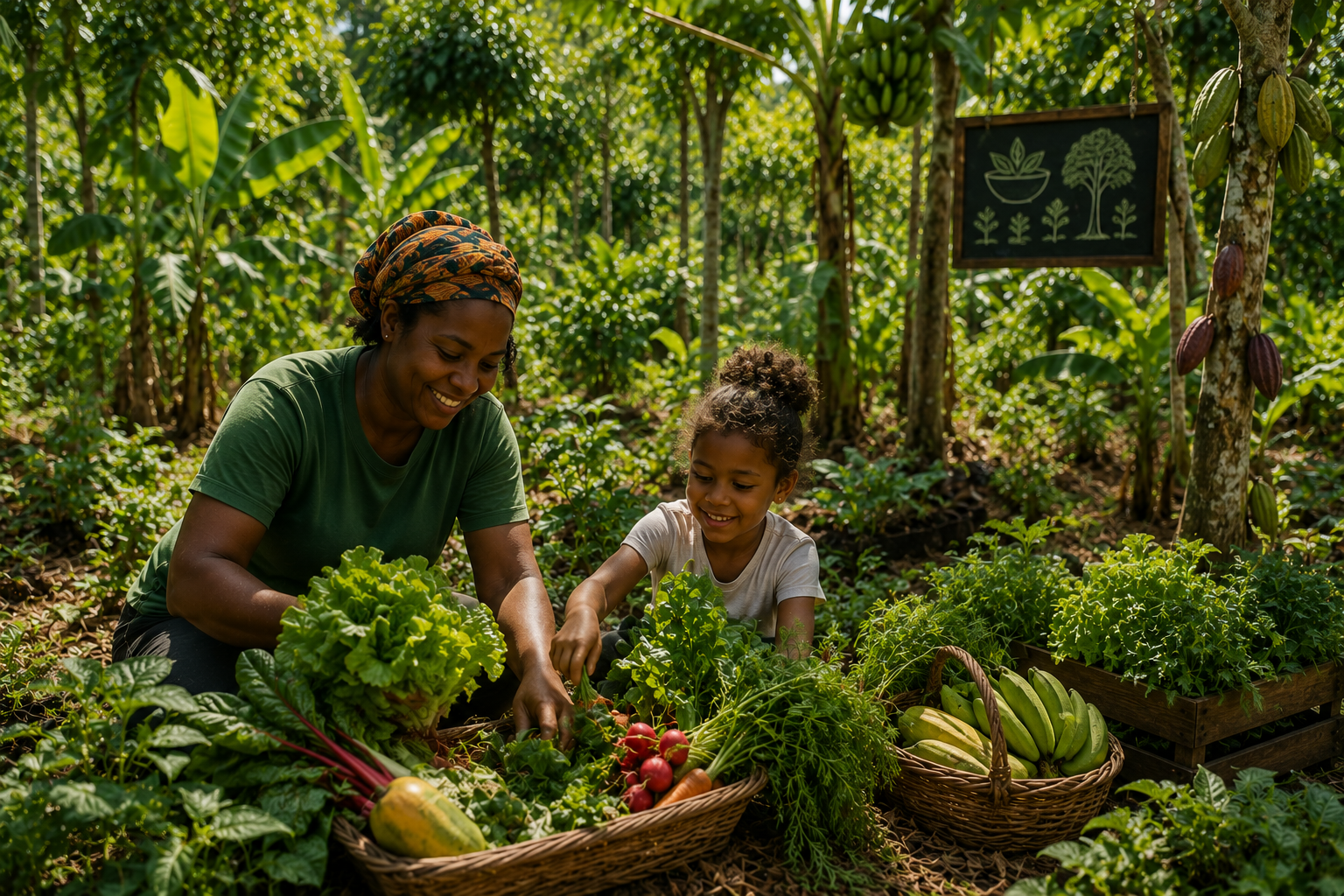
When we talk about food security, it's common to think only about the quantity of food available. But real food security also involves nutritional diversity, predictable income, and resilience in the face of extreme weather events — and it's exactly on these three fronts that Agroforestry Systems show their strength for producer families.
Across the projects GeoPlantio develops with small rural producers, a pattern keeps repeating: families who adopt well-planned SAFs report not just higher income, but a shift in their relationship with food itself — they start consuming, themselves, part of the diversity of fruits, vegetables, and roots they produce, reducing dependence on outside purchases.
Why monoculture weakens food security
A property that depends on a single crop is exposed to three simultaneous risks: climate risk (a drought or frost can wipe out an entire harvest), market risk (a price drop for a single product hits 100% of income), and nutritional risk (families who grow a single cash crop often buy processed food for their own consumption instead of diversifying production).
SAFs tackle all three risks at once, spreading production across multiple species with different cycles, different climate tolerances, and different market windows.
How a SAF builds food security in practice
- Diversity on the table: families with an established SAF typically have direct access to fruits, vegetables, tubers, and herbs throughout nearly the entire year, reducing food spending and improving diet quality.
- Staggered income: different species produce at different times of year, creating a steadier income flow than a single harvest concentrated in a few months.
- Climate resilience: species diversity, with varying tolerances to drought, shade, and temperature, reduces the chance of total production loss during adverse weather events.
- Lower costs: reduced dependence on outside inputs and processed food purchases frees up part of the family's income for other priorities.
An example SAF composition focused on food security
In projects with this focus, we prioritize short-cycle species that start producing quickly — like vegetables, cassava, and banana — combined with medium-cycle species, such as coffee and regional fruit trees, and long-cycle native forest species, which secure the system's environmental function and, down the line, can also generate income through sustainably managed timber or non-timber products like fruits and seeds.
This combination ensures the family has something to eat and something to sell from the first months, without having to wait years for returns from the longer-cycle forest species.
"Food security isn't just having food. It's having varied food, knowing where it comes from, and not depending on a single factor to guarantee it." — Marcos Lima Pereira, Forest Engineer, GeoPlantio
The role of technical support
A poorly planned SAF can actually reduce, rather than increase, a family's food security — for example, if species with incompatible light needs are planted too close together, competing for resources and reducing overall productivity. That's why technical support in the first years of implementation matters just as much as the system's initial design.
GeoPlantio's team supports management during the most critical periods, adjusting pruning, spacing, and fertilization as the system develops, until the producer family has full autonomy to run the SAF on its own.
A model that connects to other projects
Many families who now maintain SAFs focused on food security began their relationship with GeoPlantio through other projects — receiving seedlings from our community nursery, taking part in planting drives, or through Legal Reserve restoration programs. That's one of the aspects we value most in our work: how different fronts of action connect and reinforce each other over time, within the same territory.
Want to set up a food-security-focused SAF for your family or community?
Our team handles the diagnosis and full technical design, with support through the first years.
Talk to our team