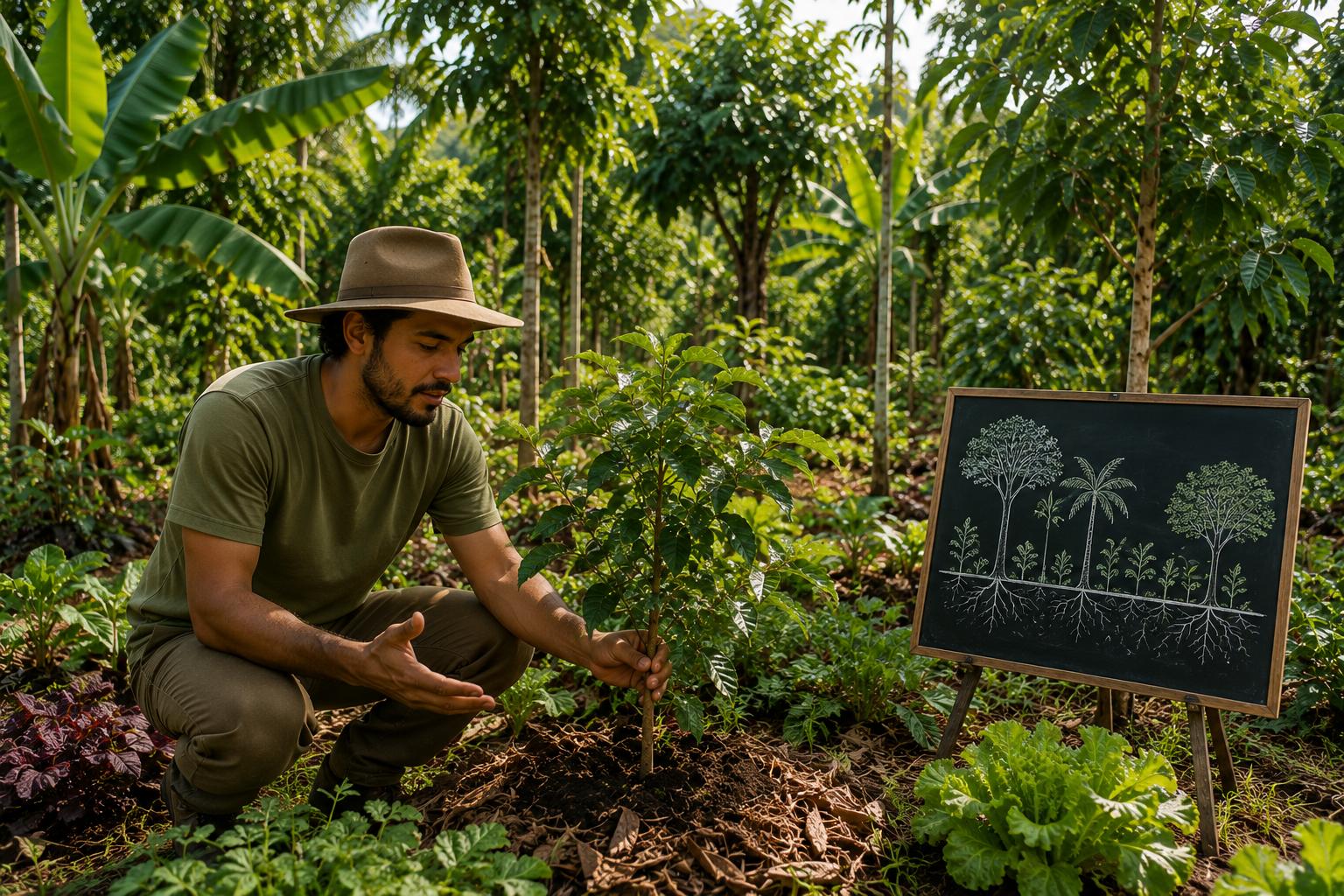
Agroforestry Systems, or SAFs, are one of the most powerful — and still underused — tools for reconciling food production, income generation, and environmental recovery on the same piece of land. In this article, we explain what they are, how they work, and why GeoPlantio invests so heavily in them.
Instead of treating "producing food" and "preserving forest" as opposing goals — as conventional agriculture usually does, typically requiring deforestation to plant — SAFs combine native trees, fruit species, agricultural crops, and in some cases livestock, on the same area, mimicking the structure of a natural forest.
How it works, in practice
A well-planned SAF organizes species into strata, similar to the floors of a forest:
- Emergent stratum: large native trees that form the upper canopy, providing timber, shade, and long-term ecological services.
- Upper stratum: medium-to-large fruit trees, such as jackfruit, açaí, or cacao, depending on the region.
- Middle stratum: smaller fruit and shrub species, such as coffee, banana, and papaya.
- Lower stratum: vegetables, tubers, and short-cycle plants, which generate quick income while longer-cycle species develop.
This layered structure makes better use of sunlight, protects soil from erosion, retains moisture, and creates a more stable microclimate — all while delivering harvests at different times of the year, reducing dependence on a single income source.
Why SAFs work where monoculture fails
Monoculture extracts nutrients from the soil repeatedly and intensively, requiring more and more chemical inputs to maintain productivity. SAFs do the opposite: species diversity recycles nutrients across different soil layers, constant canopy cover reduces the need for irrigation and weed control, and the presence of trees attracts pollinators and natural pest predators.
The result is a productive system that becomes more resilient over time, rather than more dependent on external inputs — while also serving an environmental restoration function in Legal Reserve areas or environmental liability recovery.
Benefits for growers
- Income diversification: different products harvested at different times of year reduce the financial risk of depending on a single crop.
- Lower costs: reduced need for fertilizers and chemical inputs over time.
- Land value: areas with well-established SAFs tend to maintain greater soil fertility in the long run.
- Environmental compliance: SAFs are recognized by environmental legislation as a valid restoration strategy in certain rural areas.
Environmental benefits
A mature SAF sequesters carbon, protects springs and water bodies, reduces soil erosion, and creates ecological corridors connecting fragments of native forest, allowing wildlife to move between previously isolated areas. In extremely fragmented Atlantic Forest regions, like Espírito Santo, this "ecological bridge" role is especially valuable.
"A well-designed SAF proves, in practice, that producing food and restoring forest aren't opposing goals — they're the same thing, seen through the right lens." — Marcos Lima Pereira, Forest Engineer, GeoPlantio
How GeoPlantio structures a SAF project
Our process starts with a site diagnosis — soil, climate, water availability, and the economic goal of whoever will manage the system. From there, we design the species composition and spacing, set the implementation schedule (since short- and long-cycle species enter at different times), and support management in the first years, the most critical period for the system's establishment.
We work both with small rural producers looking to diversify income and with companies that need to meet Legal Reserve restoration or environmental offset requirements — SAFs serve both profiles, with different designs for each objective.
A system that pays for itself over time
The initial investment in a SAF is higher than in a conventional forest planting, since it involves more species and closer management in the first years. But unlike pure forest restoration — which generates no direct income — a SAF starts producing financial returns from the first cycles, through short-cycle species, while the long-term forest and fruit species develop in the background.
Want to set up an Agroforestry System on your property?
We handle the diagnosis, technical design, and implementation support for your SAF.
Request a quote